
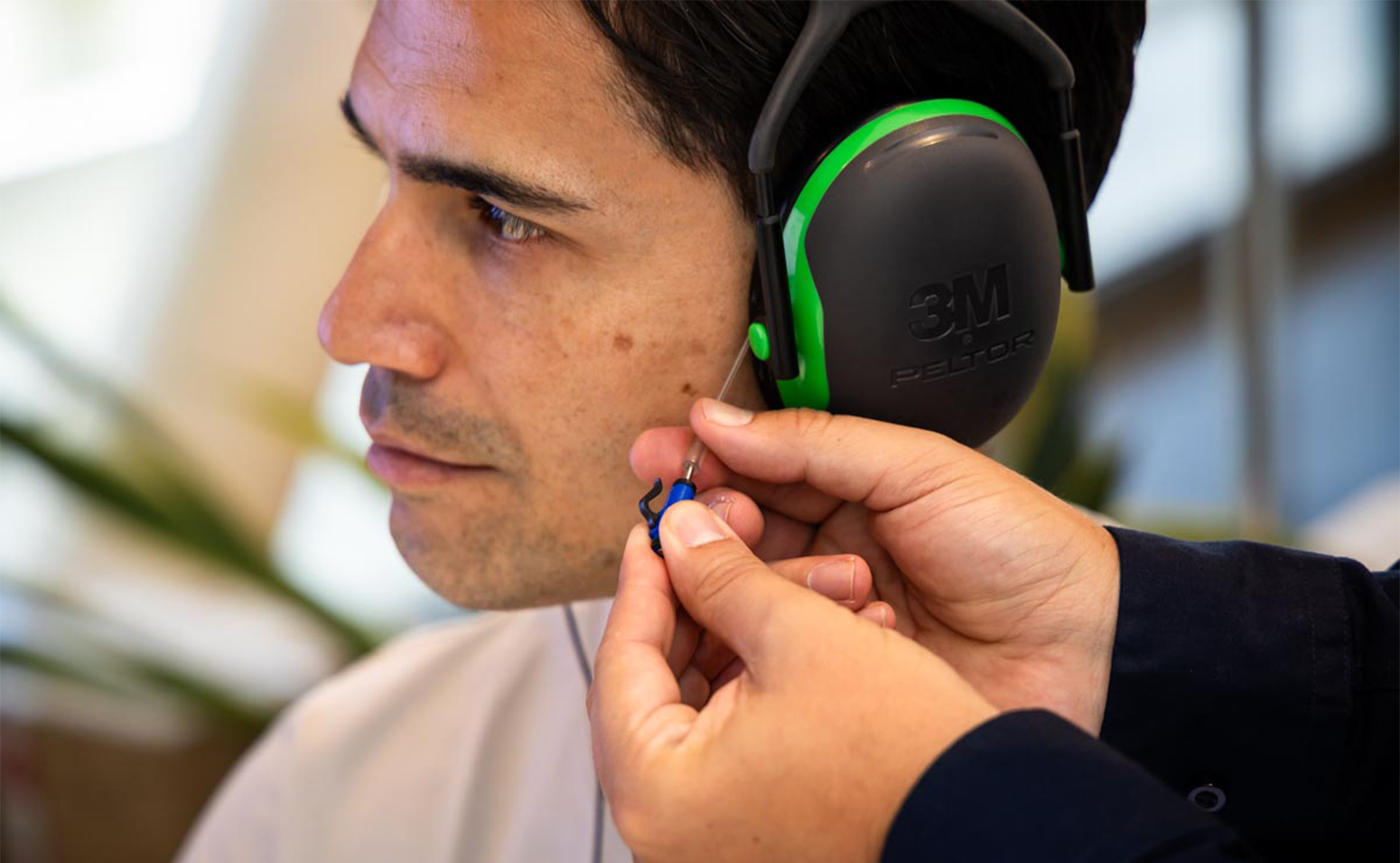
Service: Ear Fit Validation
STOP provides a certified Ear Fit Validation service for Hearing Protection Devices (HPDs), ensuring that the specific model and size of an earplug or earmuff fits the user’s ear correctly and delivers the required level of noise attenuation in real-world conditions.
The procedure is carried out by certified personnel, in accordance with established international guidelines and standards (e.g. EN 17479, EN 458, EN ISO 4869) and standardised testing procedures.
What is the E-A-Rfit™ Validation System?
Ear Fit Validation (hearing protection fit testing) is a test that measures the actual noise attenuation achieved by a specific hearing protection device as worn by an individual user. The result is expressed as a Personal Attenuation Rating (PAR), in dB.
Since the shape and size of the ear canal vary significantly from person to person, the same earplug does not necessarily provide the same level of protection for everyone. An inadequate fit can drastically reduce protection, potentially leading to dangerous noise exposure and occupational hearing loss.
Note: Manufacturers’ laboratory attenuation ratings (SNR) represent ideal conditions and sample averages. Actual protection in the workplace is often significantly lower. Ear Fit Validation determines the user’s actual, individual level of protection.
STOP’s Testing Method and Equipment
STOP performs Ear Fit Validation using the 3M™ E-A-Rfit™ Dual-Ear Validation System, which applies the objective F-MIRE (Microphone In Real Ear) measurement method.
The system measures both ears simultaneously within seconds and calculates the Personal Attenuation Rating (PAR) for each ear.
- Measurement system: 3M™ E-A-Rfit™ Dual-Ear Validation System (F-MIRE method, objective measurement).
- Measurement across 7 frequencies (125 Hz – 8000 Hz), with PAR calculated separately for each ear (left/right) and overall.
- Hearing protection devices tested: Exclusively 3M™ models, covering a wide range of products, including earmuffs (3M™ PELTOR™) and earplugs (3M™ E-A-R™). The appropriate model and size are selected according to each employee and their specific job requirements.
- Special probed versions of each hearing protection device are used, as required by the E-A-Rfit system for testing.
- Dedicated software immediately generates a report showing the results (PAR, pass/fail) and compares them against the workplace noise exposure level.
The test is considered successful (pass) when the measured PAR provides sufficient noise attenuation for the employee’s specific noise exposure level.
User Preparation Before Ear Fit Validation
To ensure reliable results, the following basic preparation requirements must be met:
- Clean and healthy ear canal: Testing is not performed in cases of excessive earwax accumulation (earwax blockage), infection, irritation or any other condition that may prevent proper fitting. If there is any doubt, an otoscopic examination is recommended.
- The user must be trained in the correct fitting (donning) of the specific hearing protection device before testing (e.g. correctly rolling and inserting foam earplugs, pulling the ear upward and backward to straighten the ear canal).
- The individually assigned model and size that will actually be worn at work must be used, ensuring that the test results are representative of real working conditions.
- Confirmation that the user has no contraindications to wearing HPDs and understands the importance of proper fitting.
Why Is Ear Fit Validation Essential?
- Confirms correct fitting and the actual level of protection provided by hearing protection devices.
- Reduces the risk of occupational hearing loss caused by noise exposure.
- Helps identify the most appropriate hearing protection device (model/size) for each employee.
- Supports compliance during audits and inspections and strengthens the workplace hearing conservation program.
What Does the Service Include?
- Individual measurement of each employee’s Personal Attenuation Rating (PAR) using the 3M™ E-A-Rfit™ system (F-MIRE).
- Fit testing of both earplugs and earmuffs.
- Training and demonstration of correct fitting techniques, with immediate retesting until an adequate level of protection is achieved.
- Comparison of the measured PAR against workplace noise levels to verify the adequacy of protection.
- Issuance of an Ear Fit Validation certificate/report.
- Guidance on proper use, maintenance and retesting.
When Is Retesting Required?
- When changing the model, type or size of the hearing protection device.
- When workplace noise levels or the nature of noise exposure change.
- At regular intervals, as a good practice (e.g. annually, as part of the hearing conservation programme).
- Following changes in ear anatomy or condition (e.g. medical/surgical procedures or recurring ear infections).
- When introducing or changing other PPE worn on the head that may affect the fit (e.g. safety glasses, helmets or respirators).
- When there are indications that the employee is not fitting or wearing the hearing protection device correctly or consistently.
Who Is This Service For?
- Industrial facilities and technical projects involving noise exposure.
- Workplaces with noise levels above the applicable exposure action values (e.g. ≥ 80 / 85 dB(A)).
- Metalworking, construction, workshops, manufacturing and packaging operations.
- Maintenance teams, airports, shipyards and emergency response teams.
Request a quotation for the use of the E-A-Rfit™ Validation System by contacting us at [email protected] or by calling +30 210 4626800.